
Among the many important articles on Gothic theory and criticism written throughout the years, three stand out as fundamental readings for any serious student of the Gothic genre. It occurred to me that I should make an entry pointing out these three writings and, fortunately, they are available free online to read and/or download.
In order of the year of publication:
On the Supernatural in Poetry (1826) by Ann Radcliffe
The Uncanny (1919) by Sigmund Freud
Supernatural Horror in Literature (1927) by H. P. Lovecraft
Showing posts with label Resources. Show all posts
Showing posts with label Resources. Show all posts
Tuesday, September 24, 2013


Friday, September 20, 2013
 The Devil Commands (1941, 65 mins, B&W) directed by Edward Dymtrk, stars Boris Karloff as a scientist studying brain waves who becomes obsessed trying to communicate with his recently deceased wife who was killed in a car crash. This film is considered the best and most interesting of the Columbia horror film series of that era (Dixon, 56). An eerie atmospheric tone is set immediately reminiscent of the movies The Haunting (1963, based on Shirley Jackson's novel, The Haunting of Hill House, 1959) and Alfred Hitchcock's Rebecca (1940, based on the 1938 novel of the same name by Daphine DuMaurier). In a voice-over the main character in Rebecca begins her tale, "Last night I dreamt I went to Manderley again..." In The Devil Commands a similar foreboding tonal quality is captured with the voice-over that begins the movie, "No one goes near my father's house. No one dares..." That same mysterious cadence is captured in The Haunting by the character, Mrs. Dudley, who reminds the guests of Hill House, "We live in town, miles away... there won't be anyone around if you need help... We couldn't hear you. In the night. No one could. No one lives any nearer than town. No one will come any nearer than that. In the night. In the dark."
Available for rental at Netflix - The Devil Commands
The Seventh Victim (1943, 131 mins, B&W) directed by Mark Robson and produced by famous Val Lewton, starring Tom Conway, Jean Brooks and introducing Kim Hunter. This intelligent psychological horror film (shot in 24 days in May 1943) rates among Lewton's best. Mary (Kim Hunter) leaves boarding school to go to New York to search for her missing sister Jacqueline (Jean Brooks) who, Mary discovers, has been abducted by a group of Satan worshipers. According to Dixon, the film perfectly reflects Lewton's personal views on the tenuousness of existence (Dixon, 47). This is a tale of murder and intrigue set in a world where evil exist and the forces to defeat it are weakened in their efforts.
The Seventh Victim is a bleak, somber film populated with people who try to escape their preoccupation with death (Soren, 125). Close-ups, up-angle shots, and shadows all add to the film's noir atmosphere. A sense of hopelessness permeates the film in which its characters struggle to survive as they lead lives of quiet desperation.
Available for rental at Netflix - The Seventh Victim
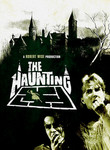 The Haunting (1963, 112 mins, B&W) directed by Robert Wise, starring Julie Harris and Clara Bloom. Based on the Shirley Jackson novel, The Haunting of Hill House. This classic horror movie is about a paranormal investigator who recruits three people to help uncover the secrets of Hill House, a
mansion overwhelmed by spirits of its former residents. This is a first-class psychological horror thriller!
The Haunting (1963, 112 mins, B&W) directed by Robert Wise, starring Julie Harris and Clara Bloom. Based on the Shirley Jackson novel, The Haunting of Hill House. This classic horror movie is about a paranormal investigator who recruits three people to help uncover the secrets of Hill House, a
mansion overwhelmed by spirits of its former residents. This is a first-class psychological horror thriller!Available for rental at Netflix - The Haunting
Seance on a Wet Afternoon (1964, 115 mins, B&W) directed by Bryan Forbes, starring Kim Stanley and Richard Attenborough. This is a well-acted, excellent scarey paranormal movie.
Available for rental at Netflix - Seance on a Wet Afternoon
__________
Dixon, Wheeler Winston. A History of Horror. New Brunswick, Rutgers University Press, 2011.
Soren, David. The Rise and Fall of the Horror Film. Baltimore, Luminary Press, 1997.
Sunday, January 3, 2010
The Use of Labels on Gothic Quest
Labels are used to group together like entries on a blog (or other types of applications). Their use are fairly obvious but this entry explains how various labels are used here on Gothic Quest.
In an attempt to cross-reference the entire blog, the following LABELing convention is explained below:
Anthologies - whenever one or more anthology titles are referred to in an entry. An anthology is a collection of selected items by various authors.
Authors - whenever the name of one or more authors are mentioned in an entry.
Collections - whenever the title of one or more collections are referred to in an entry. A collection is generally a group of selected items by the same author.
Critique - an entry that contains a critical analysis of one or more works.
Doppelganger - An entry in which the doppelganger motif is mentioned or discussed. Also interchangeably termed: The Double, The Twin, The Other.
Films - an entry in which one or more film titles are mentioned.
Novels - an entry in which on or more novel titles are mentioned.
Poems - an entry in which one or more poems are mentioned.
Resources - an entry in which one or more non-fiction sources are referenced. The resource(s) may be complete books, book sections, articles or any combination of resources.
Reviews - an entry that is either a review of one or more works or makes reference to such reviews.
Short Stories - an entry that discusses or mentions by title one or more short stories.
Titles - whenever a title of any kind is mentioned or discussed in an entry.
All the above labels have been applied to this entry to serve as an example. In addition to the above labels, others may be used as needed.
Subscribe to:
Posts (Atom)
